
Do you need to know your network adapters MAC address (media access control)?
You can use the command prompt to quickly retrieve your network adapters MAC address using a simple getmac command.
What’s even better, if you’re a system administrator you can also use this command to get the MAC address of a remote computer on your network.
Open Command Prompt as Administrator
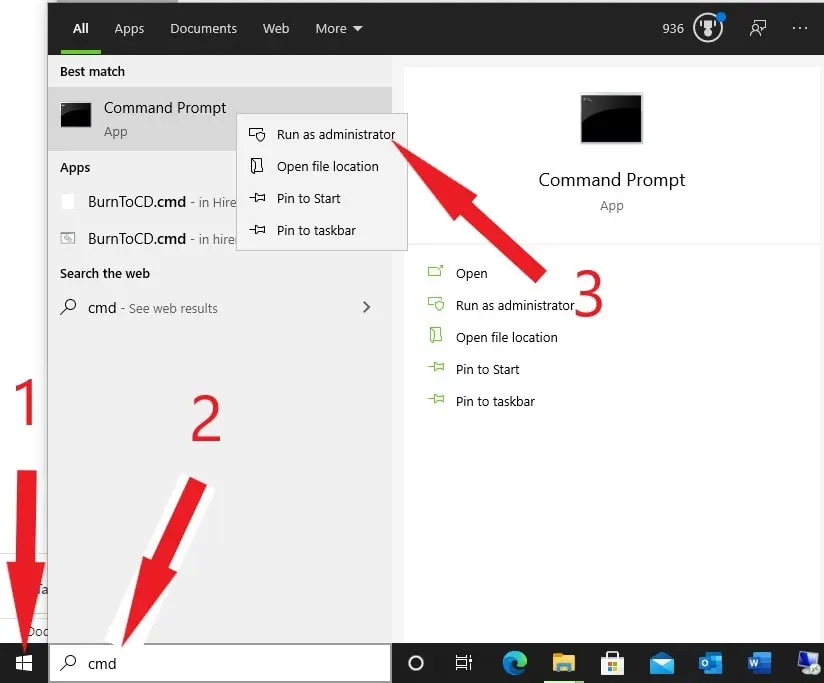
- Press the Windows Key
- Type cmd and press return
- Right Click the Command Prompt icon and select ‘ Run as Administrator’
Type the command
In the command prompt window enter the below command and press return
getmac
You’ll be given a list of network adapters installed on your computer and their unique MAC address
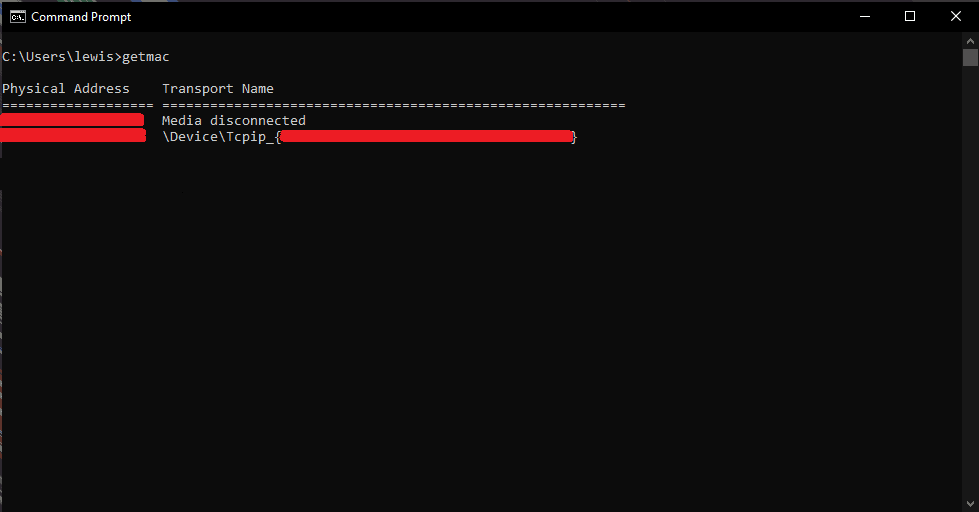
getmac command options
The getmac command has some advanced options that can be really helpful for running more advanced queries.
For example, if you want to run the command on a remote computer you can use the /s option followed by the computer name or IP address.
Here is a full list of parameters that can be combined with the getmac command.
GETMAC [/S system [/U username [/P [password]]]] [/FO format] [/NH] [/V]
Description: This tool enables an administrator to display the MAC address for network adapters on a system.
Parameter List: /S system Specifies the remote system to connect to.
/U     [domain\]user     Specifies the user context under
                         which the command should execute.

/P     [password]        Specifies the password for the given
                         user context. Prompts for input if omitted.

/FO    format            Specifies the format in which the output
                         is to be displayed.
                         Valid values: "TABLE", "LIST", "CSV".

/NH                      Specifies that the "Column Header" should
                         not be displayed in the output.
                         Valid only for TABLE and CSV formats.

/V                       Specifies that verbose output is displayed.

/?                       Displays this help message.
Examples: GETMAC /? GETMAC /FO csv GETMAC /S system /NH /V GETMAC /S system /U user GETMAC /S system /U domain\user /P password /FO list /V GETMAC /S system /U domain\user /P password /FO table /NH
Keep reading
 Workplace IT Fix Copilot button missing in Microsoft Teams If the Copilot button is missing in Teams after licensing, deleting the MSTeams LocalCache folder and restarting Teams fixed it for me.
 Workplace IT Password Generator A free password generator. Choose a length and which character types to include, then generate a password.